Black Pudding
Breakfast | British
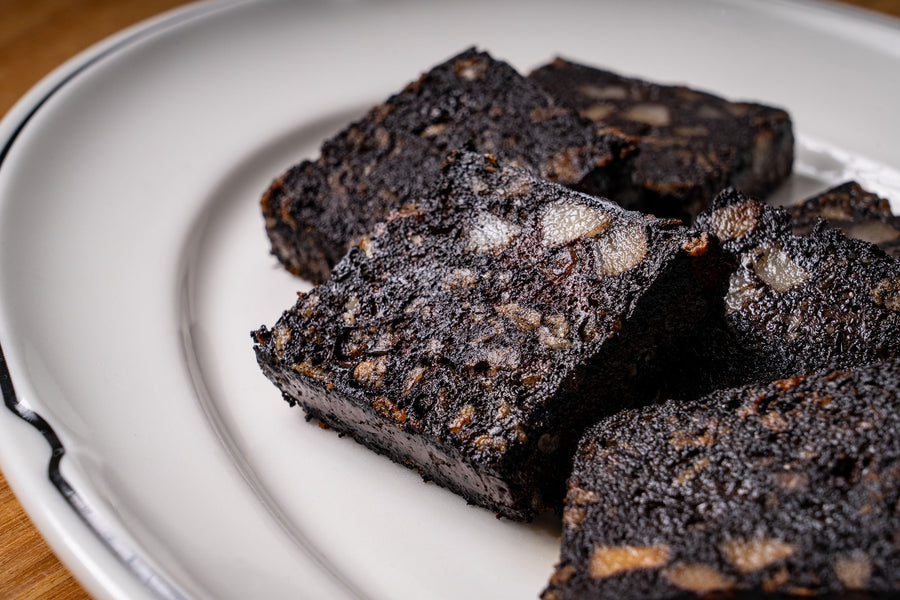
Black pudding is a blood sausage from Britain and Ireland, made by setting fresh pig’s blood with diced pork fat, oats and warm spices. I wasn't sure whether I should out this recipe online as I didn't know how many people would actually make it. But I have had a requests so here it is.
I cook mine gently in a water bath in a low oven, so the outside doesn’t overcook before the centre reaches 72°C (161°F). That gentle heat gives you a smooth, dense slice rather than a dry, crumbly one.
Traditionally it’s piped into casings, but I set mine in a loaf tin. It’s easier to manage at home, there’s no need for a sausage stuffer, and once it’s chilled overnight you can cut it into neat logs and slices. The diced back fat stays as small pockets through the pudding. When you fry a slice, the outside crisps while those pockets render and baste it from the inside. I serve it as part of a cooked breakfast, but it’s just as good with seared scallops or a fried egg on toast.
Ingredients
- 1L fresh pig’s blood, strained
- 2 medium brown onions
- 330g pork back fat, rind removed
- 160ml double (heavy) cream
- 1 ½ tsp fine salt
- 1 1/3 tsp ground allspice
- 1 1/3 tsp ground coriander
- ⅔ tsp ground nutmeg
- 1 tsp ground white pepper
- 1/3 tsp chilli flakes
- 50g (½ cup) oats
- butter for greasing and frying
Directions
- Finely dice the onions and set aside.
- Heat an oven to 130°C (265°F) fan bake or 150°C (300°F) without a fan. Cut the back fat into 5mm dice. Set aside about 2 tablespoons of the fat to cook the onions in and refrigerate what's left.
- Melt the reserved 2 tablespoons of fat in a pan over low heat. Add the onions and gently sweat for 15 minutes until very soft, without browning them. Add the oats to the pan and toss through the onions. Tip the mixture onto a flat tray and let it cool at room temperature.
- Strain the blood into a large mixing bowl. Add the cream, salt, allspice, coriander, nutmeg, white pepper and chilli flakes. Add the cooled onions and diced fat before stirring well.
- To check the seasoning, fry a teaspoon of the mixture in a frying pan until firm. Taste and adjust the seasoning if needed.
- Grease your loaf tin. Stir the mixture again and pour it in. Cover tightly with foil.
- Put the tin in a roasting tray and add boiling water to come halfway up the sides. Bake for 75 to 90 minutes. After 20 minutes, stir gently to distribute the fat throughout, then re-cover with foil.
- It’s cooked when it has a firm texture, a skewer inserted into the centre of the tin comes out without liquid blood and the centre reaches at least 72°C (161°F).
- Carefully remove the tin from the roasting tray and leave it to cool on a wire rack, at room temperature. Once cool, cover and transfer to the refrigerator overnight.
- Slice lengthwise into three rectangular logs. Slice each log into 1.5 cm slices.
- To serve, fry each slice in a little butter or oil for 2 to 3 minutes per side.
Recipe notes
Pig’s blood
This is the base of the recipe, so source it properly. Most butchers can order it in with a few days’ notice, and Asian butchers often keep it in stock. It usually comes frozen, so thaw it completely in the fridge before you start. Pass it through a fine sieve even if it’s sold as strained. Any clots or icy pieces left in will set as hard lumps through the pudding.
Pork back fat
Back fat is the firm layer of fat from along the pig’s back. It’s harder than belly fat and holds its shape when diced, which gives you those distinct white pieces through each slice. Ask your butcher for it with the rind removed. Cut it into an even 5mm dice so it all cooks at the same rate, and keep it cold until it goes into the blood so it doesn’t soften and smear.