Thai BBQ Chicken (Gai Yang)
Dinner | Thai
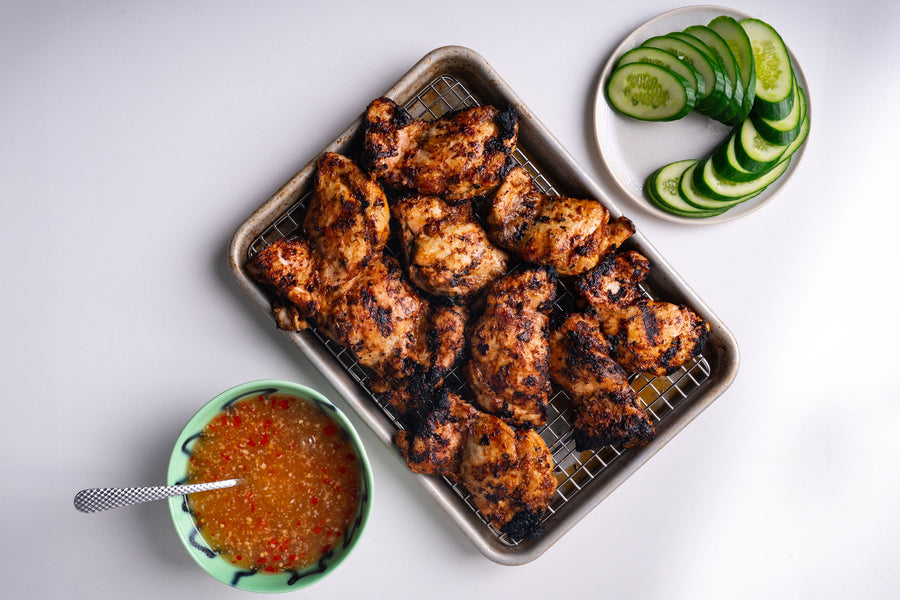
Gai Yang is BBQ chicken from northeastern Thailand, rooted in the food traditions of the Isaan region and influenced by Lao cooking.
This dish is all about the marinade which has lemongrass, coriander roots, garlic, palm sugar, fish sauce and dark soy sauce blended into a fragrant paste that coats the chicken and chars on the grill. The palm sugar caramelises under high heat, which is where that deep colour and slightly smoky-sweet crust comes from. It’s a simple technique, but you'll end up with some very tasty chicken. I’ve used boneless thighs here because they cook evenly, stay juicy under direct heat and hold up to the acid in the marinade without going stringy.
The Nam Jim Gai is the other half of the dish: a sweet, sour and gently spiced dipping sauce made with rice vinegar, fresh chilli and garlic, thickened with tapioca starch to a glossy consistency. Make the sauce while the chicken marinates and it’ll be cooled and ready by the time you fire up the grill. Serve with steamed jasmine rice and sliced cucumber.
Ingredients
- 1 shallot
- 1 lemongrass
- 4 cloves garlic
- small handful coriander roots
- 1 tsp palm sugar
- Juice of 1 lime
- 1 tbsp neutral flavoured oil (like peanut)
- 1 tbsp Thai dark soy sauce
- 1 tsp rice vinegar
- 1 tbsp fish sauce
- ground white pepper, to season
- 8 chicken thighs, boneless, skinless
- steamed rice, sliced cucumber, to serve
- NAM JIM GAI
- 4 cloves garlic
- 3 to 4 red Thai chilies
- 120g caster sugar
- 120ml rice vinegar
- 120ml water, + 20ml extra for slurry
- 1 tbsp fish sauce
- 1 tsp tapioca starch
- salt, to season
Directions
PREP THE MARINADE
- Roughly chop the shallot and finely chop the lemongrass stem. Place in a small food processor with the garlic, coriander roots, palm sugar, lime juice, oil, soy sauce, rice vinegar and fish sauce. Season with some white pepper and process until a rough paste.
- Transfer to a large bowl and add the chicken thighs. Mix well until the chicken is completely coated. Cover and refrigerate for 2 hours to marinate, up to overnight.
MAKE NAM JIM GAI
- Place the water, rice vinegar, sugar and fish sauce in a medium saucepan. Season with salt and place over a medium heat.
- Bring to a gentle simmer, stirring until sugar dissolves.
- Roughly chop the garlic and chillies and process in a small food processor until finely minced. Transfer to the saucepan and mix through. Simmer for 2-3 minutes.
- Mix the tapioca starch with the extra water in a small bowl to a slurry, then add to the saucepan. Bring to a boil, stirring continuously, and cook for 1 minute until thickened slightly and glossy.
- Remove from the heat and allow to cool completely.
GRILL CHICKEN AND SERVE
- Preheat a lightly oiled BBQ grill or grill pan over medium-high heat.
- Remove the chicken from the marinade and grill, turning to char well on both sides, about 6-8 minutes, until the internal temperature reaches 65°C.
- Remove from the grill and set aside to rest for 5 minutes. It will come up to 70°C-72°C in temperature while it rests.
- Serve the chicken with some steamed rice, sliced cucumber and Nam Jim Gai.
Recipe notes
Palm sugar:
A dense, amber-coloured sugar made from the sap of the palmyra palm, with a mild caramel depth that refined white sugar doesn’t have. It comes in solid discs or blocks, so chop or grate it before it goes into the processor. It also caramelises more readily than white sugar, which contributes to the char on the grill. If you can’t find it at an Asian grocer, caster sugar or brown sugar are the closest substitutes. Brown sugar will add a slight molasses note, but it works well.
Lemongrass:
Only the lower pale section of the stalk is used: the upper green leaves are fibrous and add very little flavour. Peel away the outer layer to expose the more tender core, then chop as finely as you can before it goes in the processor. The finer you chop it beforehand, the smoother the marinade paste will be. Lemongrass keeps well in the fridge for a few weeks and also freezes without any loss of flavour.
Coriander roots:
The roots carry a much more concentrated, earthier flavour than the leaves, and they hold up better under heat and acidity, which makes them ideal for marinades. Most supermarket bunches still have the roots attached: trim them off, rinse away any soil and add them straight to the processor. If your bunch has been trimmed at the base, the lower stems are a reasonable substitute, though the flavour will be a little lighter.