Korean Fried Chicken Burger
Lunch | Korean
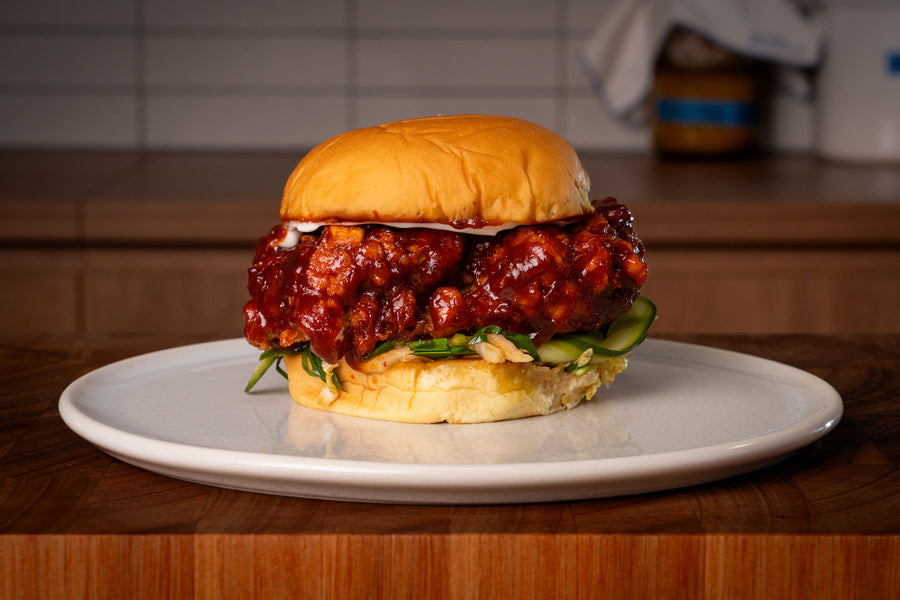
Korean Fried Chicken has become a viral recipe over the past few years and I'm honestly not surprised. It's an incredible burger. And even though it does take a bit of time (and steps) to make it, it's one of my favourites and is always a big hit with friends.

What is it?
Korean fried chicken burger is made with chicken thighs, double-fried for a great crunch, then tossed in a gochujang sauce with heat, sweetness and fermented depth. Then, we'll layer a soft potato bun with the chicken, a quick-pickled cucumber, a dressed slaw and mayo.
A double-fry
We're going to double-fry the chicken to ensure we get an extra crispy chicken. The first fry at 175°C sets the coating and cooks the chicken through. The second fry at 190°C drives the remaining moisture out of the crust and gives you the crunch that holds up under the sauce. The Korean sauce, pickled cucumber and slaw can all be made while the chicken marinates, so the frying at the end is the only thing that needs your attention.
The sauce
It's the best part of the burger, it's add so much flavour to the chicken. It's sweet, sour and has a little bit of heat but not much. The recipe makes a little more than you need because you want to cover the chicken in it, and I always like some extra in the fridge to put on the grilled chicken and rice I'm cooking tomorrow.
Ingredients
- 4 chicken thighs, (skinless and boneless) trimmed
- thumbsize piece of fresh ginger, grated
- 2 garlic cloves, finely grated
- 1 tsp sea salt
- ½ tsp ground black pepper
- 4 potato buns, (see separate recipe for homemade)
- softened butter, for toasting
- mayonnaise, for serving
- KOREAN SAUCE
- 1 tbsp neutral flavoured oil
- 8 cloves garlic
- ½ cup Gochujang
- ½ cup tomato ketchup
- 2½ tbsp hot honey
- 2 tbsp rice wine vinegar (or apple cider)
- 2 tsp salt
- 2 tbsp soy sauce
- ⅓ cup (80ml) water
- SALAD
- 2 Lebanese cucumbers
- ⅓ cup rice vinegar
- ⅓ cup water
- 2 tsp sea salt
- 2 tsp caster sugar
- 1 baby wombok cabbage (napa cabbage), shredded
- 4 spring onions, sliced
- ¼ cup chopped garlic chives
- DRESSING
- 1 tbsp korean soy sauce
- ½ tsp gochugaru
- 2 tsp rice vinegar
- 2 tsp sesame oil
- 3 tsp hot honey
- DREDGE AND FRYING
- neutral flavoured oil (eg peanut oil), for deep frying
- 2 eggs, beaten
- 110g (¾ cup) potato starch
- 110g (¾ cup) plain flour
Directions
MARINATE THE CHICKEN
- Place the chicken thighs in a large bowl, then finely grate the ginger and garlic and mix through with the salt and cracked black pepper.
- Cover and refrigerate for at least 1 hour, up to overnight.
MAKE THE SAUCE
- Heat 1 tbsp of oil in a small saucepan over medium-low heat. Finely grate the garlic and add to the pan. Stir through the salt and sauté for 2–3 minutes, taking care to not allow it to colour.
- Add the rice wine vinegar and stir. Then, add the gochujang. Cook for 1 minute, then add the ketchup, hot honey, soy sauce and water.
- Stir well and bring to a simmer. Cook, stirring occasionally for 10 minutes, until slightly thickened. Set aside.
PREP THE SALAD
- In a small saucepan, combine the vinegar, water, salt, and sugar. Bring to a simmer, stirring occasionally to dissolve everything.
- While the liquid is simmering, peel the cucumbers into long ribbons into a medium heatproof bowl, discarding the core of the cucumbers as they hold too much moisture.
- Pour the liquid over the sliced cucumbers, ensuring they are fully submerged and set aside to cool.
- To make the slaw dressing, combine the soy sauce, gochugaru, vinegar, sesame oil and honey in a screw-top jar. Shake well until combined. Set aside until ready to serve.
- Then, shred the cabbage and finely slice the spring onions. Place in a large bowl with the chopped garlic chives. Set aside until ready to serve (we’ll dress the salad after we fry the chicken).
FRY THE CHICKEN
- Heat enough oil in a deep fryer or heavy saucepan to 160°C (320°F).
- In a large bowl, whisk the flour and potato starch. Crack the eggs into the marinated chicken and mix until well combined.
- Dredge the chicken pieces in the flour mixture one at a time and make sure they’re all coated. Then, add them back in the remaining egg mixture and cover. Dredge the chicken again in the flour.
- Fry the chicken in batches, for 5-6 minutes until light golden. Drain on a wire rack or paper towel lined tray.
- Increase the oil temp to 190°C (375°F). Fry the chicken again for 3-4 minutes until golden and cooked through and the internal temperature reaches 62°C (143°F). Drain again.
SAUCE AND ASSEMBLE
- While the chicken is frying, heat a large frying pan over medium heat. Spread the insides of each bun with some butter and toast until lightly golden.
- Toss the salad with the dressing, until well combined. Drain the cucumbers from their pickling liquid.
- Get your sauce ready, you may need to heat it up slightly so it’s not stiff (but you don’t want it too hot). Brush the hot chicken liberally all over with the sauce. You want the chicken to still be hot when you brush on the sauce.
- Layer some of the salad on the bases of the toasted buns. Top with a few cucumber ribbons, then the chicken. Spread a little mayonnaise on the inside of the bun top and place on top. Serve immediately.
Recipe notes
Gochujang:
A fermented Korean chilli paste made from red chillies, glutinous rice and soybeans. It has heat, sweetness, depth and a slight tang from the fermentation. You can find it at Asian grocery stores or Korean supermarkets.
Garlic chives:
Garlic chives have a flat, grass-like leaf with a mild garlic flavour distinct from regular chives. Available at Asian supermarkets and grocers. To prepare: finely slice the firm stalk ends, then chop the leafy upper part into roughly 1cm lengths. If you can’t find them, ordinary chives work as a substitute, or leave them out entirely.
Chicken thighs:
Boneless, skinless thighs are better for this than breast: the higher fat content keeps them juicy through two rounds of frying. Breast dries out faster and has less margin for error. Buy the largest thighs you can find and trim any excess sinew or fat before marinating. If they’re uneven in thickness, pound them briefly so they cook evenly.
Potato starch:
Used alongside plain flour in the dredge. Potato starch produces a lighter, crisper coating than flour alone and gives the double-fried crust the structural quality that holds up under the sauce. Find it at Asian grocery stores. Cornflour (cornstarch) is a good substitute if you can’t find potato starch, though the coating will be very slightly less delicate.
Hot honey:
Honey infused with chilli, used in both the Korean sauce and the slaw dressing. It adds sweetness and a clean, even heat that balances the gochujang. If unavailable, substitute with regular honey and add a pinch of dried chilli flakes or a few drops of hot sauce to each use.