Duck Confit
Dinner | French
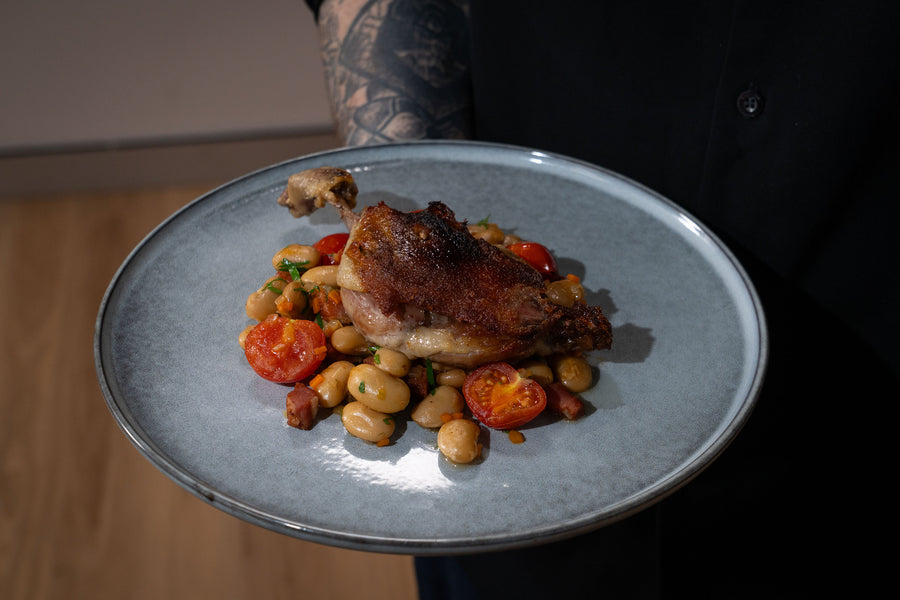
Duck confit is the showstopper art your next dinner party. Now, I know what you're thinking 'that's too hard and it will take too long'... but it's not that hard and you can prep it in advance. Trust me, it's worth it.
In traditional confit, you take your Duck leg, you make a brine out of rock salt, juniper berries, star anise, bay leaves lemon zest etc. And yes, it take a while. But I have a little work around so it's not as complicated, we're going to dry brine them instead so the brining process is easier and quicker.
Get your Duck legs, remove them from the packet 2 hours before you start cooking, season them heavily with salt and leave them on a wire rack at room temp. You can even do this the night before and leave them in the fridge.
So we're making duck confit for six and serving them on butter beans with smoked bacon and tomatoes in reduced chicken stock, with a lemony lettuce on the side.
Ingredients
- CONFIT DUCK
- 6 duck legs
- sea salt flakes
- rind of 1 lemon
- rind of 1 orange
- 4 sprigs thyme
- ½ tbsp coriander seeds
- ½ tbsp black peppercorns
- 3 star anise
- 3 dried bay leaves
- 800ml (27 fl oz) duck fat
- BUTTER BEANS WITH SMOKED BACON
- 1 L chicken stock
- 1 tbsp olive oil
- 250g speck, diced into 2cm lardons
- 2 cloves garlic, finely chopped
- 2 carrots, peeled, finely diced
- 3 shallots, finely diced
- 3 sprigs thyme
- 400g cherry tomatoes, halved
- 2 x 400g cans butter beans, rinsed and drained
- sea salt flakes and black pepper
- small bunch of parsley, chiffonade
- SALAD
- 1 head butter lettuce, leaves washed and separated
- juice of 1 lemon
- 2 tbsp olive oil
Directions
PREP THE DUCK
- Place the duck on a wire rack over a tray and sprinkle generously with salt. Set aside for 2 hours at room temperature to dry brine.
- Preheat the oven to 120°C fan forced (250°F). Melt the duck fat in a medium saucepan to around 100°C. Brush the salt off the duck then transfer to a large baking dish.
- Top duck with lemon and orange rind, 1 of the thyme sprigs, coriander seeds, peppercorns, star anise and bay leaves.
- Carefully pour the hot duck fat over the duck legs and cover with a piece of baking paper like a cartouche. Transfer to the oven and cook for 3-3 ½ hours. Checking after 3 hours for tenderness.
COOK THE ACCOMPANIMENT
- Place the chicken stock in a medium saucepan and bring to a simmer. Cook until reduced by two thirds.
- Heat 1 tbsp of the oil in a frying pan on medium heat and cook the lardons for 8-10 minutes, until browned and crisp. Transfer to a bowl and set aside.
- Add shallots, garlic and carrot to the pan and cook, stirring, for 4-5 minutes, until softened. Season with salt and pepper.
- Add thyme to pan and toss to combine. Cook for a further 1 minute, then transfer to a bowl.
CRISP THE DUCK SKIN
- Remove duck from the oven and transfer to a large frying pan, skin side down. Reserve duck fat for another use.
- Place the pan over medium heat and cook for 6-8 minutes, until the skin is crisp and golden.
FINISH AND SERVE
- Combine remaining oil and lemon juice in a small jar or jug and mix until emulsified. Toss with the lettuce and transfer to a large serving bowl.
- Transfer the reduced chicken stock to a large pan along with the tomatoes, butter beans, shallot-carrot mix (but discard the thyme), and the lardons. Stir over medium high heat until the mixture has heated through, taking care not to allow it to dry out. Add the chiffonade parsley and stir through.
- Divide bean mixture between serving plates, then top with a duck leg. Serve with butter lettuce salad on the side.
Recipe notes
Duck fat:
Rendered duck fat is the cooking medium and the preservation agent in a confit. Its low smoking point and high stability at the temperatures used here (around 120°C oven, 80-85°C in the fat) make it ideal for long, slow cooking without the fat breaking down or frying the meat. It also transfers flavour from the aromatics into the duck over the cooking time. Duck fat is available at good butchers, specialty food stores, and in jars or tins at some supermarkets. Goose fat is the closest substitute and works equally well. Do not substitute with vegetable or olive oil: the flavour, stability and preservation properties are completely different. After cooking, strain the used fat through a fine sieve and refrigerate. It keeps for several months and is exceptional for roasting potatoes.
Duck legs:
You need to use Duck Legs for confit because they have a high proportion of intramuscular fat and connective tissue relative to breast meat. During the long, slow cook, the fat renders out and the connective tissue breaks down into gelatin, which makes the flesh extraordinarily tender and self-basting. Breast meat has none of these characteristics and would dry out completely at these cooking times. Duck legs are available from specialty butchers, and can often be found frozen at Asian grocers. Look for legs with the skin intact and undamaged, as the skin is what delivers the crisp finish in the final stage.
Speck:
Speck is a cured and cold-smoked pork product originating from the Alto Adige region of northern Italy, made from the leg or belly. It has a longer curing and smoking process than most bacon, which gives it a drier texture, more concentrated flavour, and a distinctly smoky character. It’s available as a whole piece at good delis, or pre-diced at most major supermarkets. For this recipe, dice it into 2cm lardons and render it in the pan until the fat is released and the pieces are browned and crisp. If you can’t find speck, guanciale or a good quality smoked bacon will substitute, though the flavour will be less complex.