Chicken Parmesan
Lunch | American
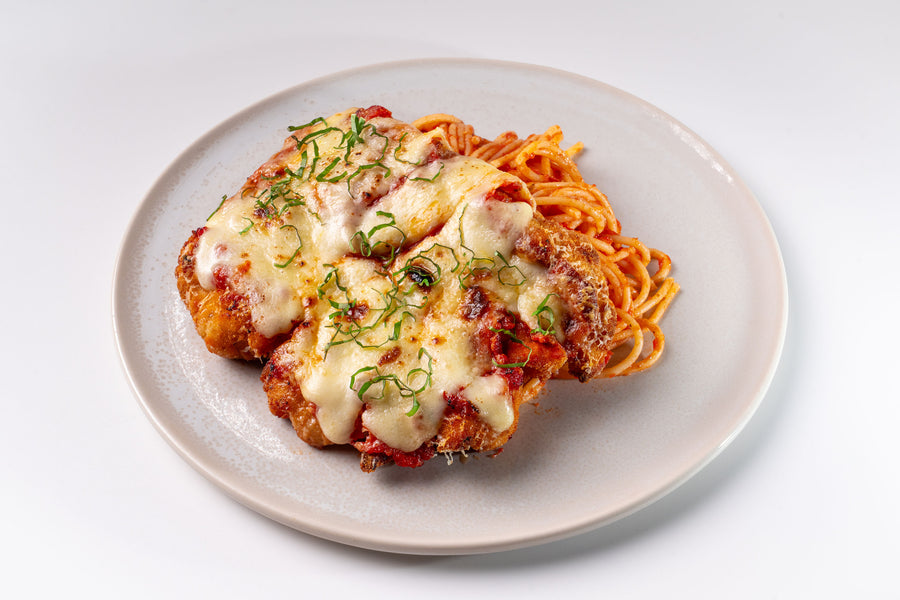
We're making the classic Italian-American chicken parmesan that's served with pasta. So it's slightly different from the classic Australian Chicken Parmi which is served with chips and salad. I must admit that I quite like the addition of pasta in this one.

Chicken Parmesan Explained
What is Chicken Parmesan?
Tender chicken breasts are coated in seasoned breadcrumbs and fried until golden brown, then topped with a rich tomato sauce, mozzarella cheese, and Parmesan cheese. Served over a bed of pasta.
It's an Italian-American dish that developed in the northeast United States during the 1940s. Italian immigrants adapted melanzane alla parmigiana, the Sicilian dish of fried eggplant layered with tomato sauce and cheese, substituting chicken because it was cheaper and more readily available than eggplant. Now, it's a staple in many Italian-American restaurants and homes.
Chicken method
The technique is a standard breaded cutlet where each chicken breast is butterflied, pounded lightly to an even thickness, and crumbed through flour, egg, and breadcrumbs before being shallow-fried until golden. The chicken then goes in the oven, under the grill with tomato sauce, mozzarella, and Parmesan to finish.
The tomato sauce is a simple garlic and crushed tomato base simmered until it thickens and the flavour concentrates. Making the sauce first means both elements are ready at the same time, and any leftover sauce goes through the spaghetti.
Ingredients
- 4 chicken breasts
- salt and pepper, to taste
- 200g (about 1 ⅔ cups) flour
- 3 eggs, beaten
- 200g (about 2 cups) panko breadcrumbs
- 2 tins crushed tomatoes
- 6 cloves garlic, diced
- 200ml (about ⅘ cup) olive oil
- 1/2 bunch basil
- 1 packet spaghetti
- 200g (about 7 oz) mozzarella cheese
- 50g (about ½ cup) Parmesan cheese, grated
Directions
BUTTERFLY CHICKEN
- Take a sharp knife and slice through the centre of each breast, opening it up so it's double the size. Place a piece of plastic film or parchment paper over the top and lightly pound to an even thickness throughout. Season both sides with salt and pepper.
- Set up your dredge station with a bowl of flour, bowl of the beaten egg and another bowl for the breadcrumbs. Dredge each chicken breast in flour, dip in beaten egg, and coat with breadcrumbs. Set aside on a wire rack until ready to cook.
COOK THE SAUCE
- In a frying pan, heat 40ml (about 2 tablespoons) of olive oil over medium heat. Add the diced garlic with a pinch of salt. Sauté for 3-4 minutes until just softened, ensuring it doesn’t brown too much to avoid bitterness. Add the tinned tomatoes and a large piece of basil. Simmer for 20 minutes, until the sauce starts to thicken and intensifies in flavour. Taste and adjust seasoning as needed.
- After the sauce has been cooking for 10 minutes, bring a large pot of salted water to a boil for the pasta.
COOK THE CHICKEN
- In a separate large, heavy pan, heat the remaining olive oil and shallow fry the crumbed chicken for 3-4 minutes each side, turning often until golden brown all over, and the internal temperature reaches at least 65°C.
- Halfway through cooking the chicken, add the pasta to the boiling water and cook according to the package instructions (typically 10-11 minutes).
- Once the chicken is golden brown on both sides and almost cooked through, transfer to an oven tray. Top each breast with a spoonful of tomato sauce, slices of mozzarella, and a sprinkle of Parmesan. Grill (broil) in the oven for 6-7 minutes, or until the cheese is golden brown and bubbly.
FINISH AND SERVE
- Drain the pasta, reserving some pasta water. Stir the remaining tomato sauce through the pasta, adding a few spoonfuls of pasta water to achieve the desired consistency. Serve the pasta on a plate with the cheesy, golden chicken on the side. Garnish with finely sliced basil, sprinkled over the chicken.
Recipe notes
Chicken breasts:
Butterflying each breast and pounding it lightly to an even thickness is essential (don't pound too hard, it's not meant to be flat). An uneven piece of chicken will cook unevenly: the thin end overcooks before the thick end reaches temperature. You’re aiming for a consistent thickness throughout, not making it paper thin, around 1–1.5cm is right. Slicing off the tapered end of the breast before pounding gives a more even, rectangular piece that sits better on the plate.
Breadcrumbs:
Go for Panko breadcrumbs. Panko gives a coarser, crunchier coating; fine breadcrumbs give a tighter, more even crumb. If making breadcrumbs from scratch, use day-old bread rather than fresh, fresh bread is too moist and the coating will be dense rather than crisp after frying.
Mozzarella:
Use low-moisture mozzarella rather than fresh buffalo mozzarella. Fresh buffalo mozzarella is packed in water and releases too much liquid under the grill, which makes the top of the chicken watery and prevents the cheese from browning properly. Low-moisture mozzarella, the kind sold in blocks or vacuum-packed balls in the deli section, melts cleanly and browns well.